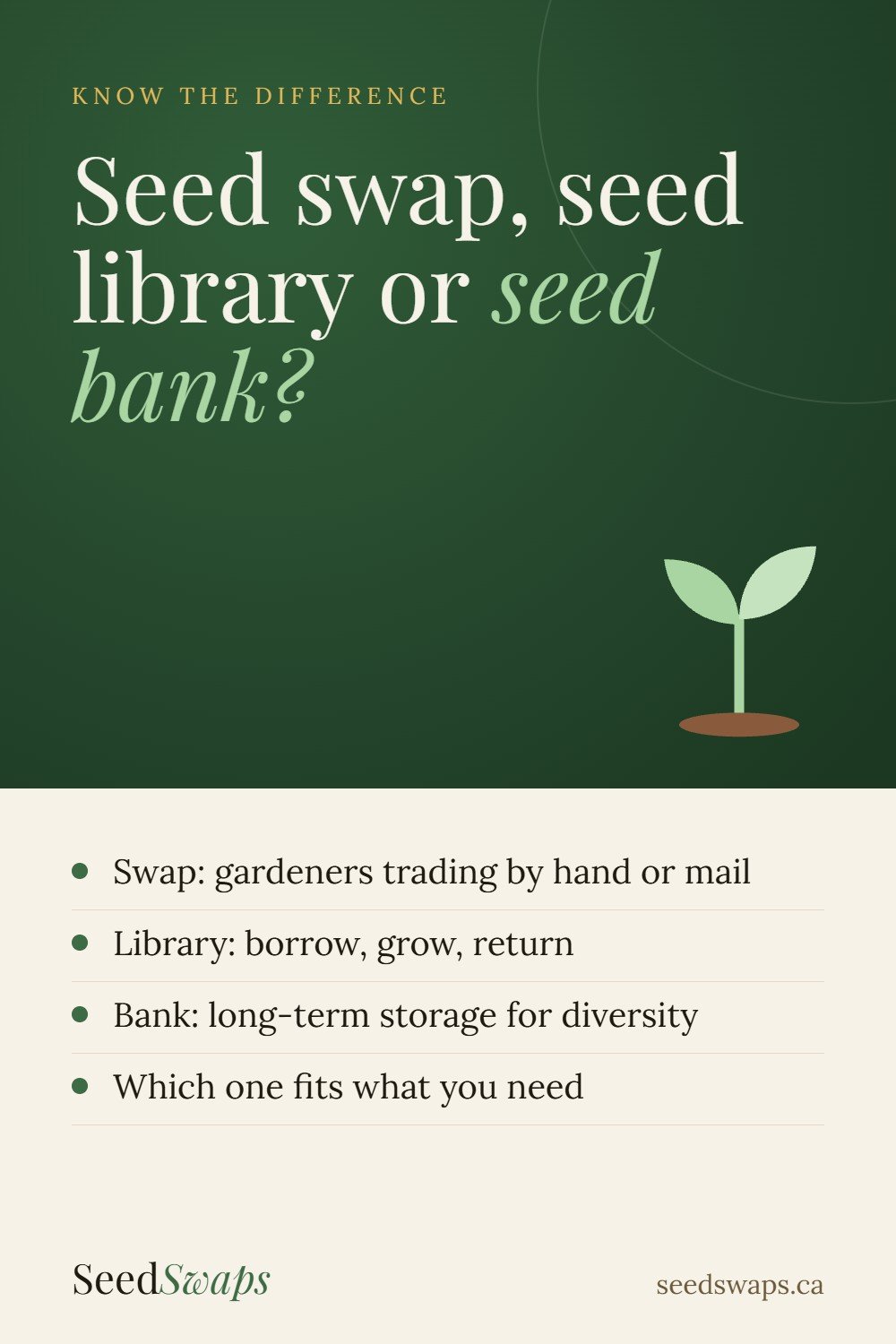
They sound alike, and people use the words interchangeably, but a seed swap, a seed library and a seed bank are three different things. Here’s how each one works, and which fits what you’re trying to do.
The short version
| What it is | How you get seeds | |
|---|---|---|
| Seed swap | Gardeners trading seeds directly with each other | Trade some of yours, or ask for a gift |
| Seed library | A collection you borrow seeds from, often at a public library | Take a few packets, grow them, return some saved seed if you can |
| Seed bank | Long-term storage of seeds to protect plant diversity | Mostly for researchers and plant breeders, not home gardeners |
What is a seed swap?
A seed swap is gardeners trading seeds with each other. You bring or mail what you’ve saved, and get something new in return. Some swaps are in-person events. In Canada the best known are Seedy Saturdays, held in dozens of towns every year, mostly from January to April. Others happen by mail, between gardeners who have never met.
Good for: varieties you can’t find in stores, heirlooms and regional varieties that do well where you live, and finding a home for extra seed.
The hard part has always been keeping track. Who has what? Did they mail it? That’s why we built SeedSwaps: real listings from Canadian gardeners, a simple way to agree on a swap, and ratings so you know who follows through.
What is a seed library?
A seed library lends seeds the way a library lends books. You take a few packets in spring and grow them. In fall, if you can, you save seed from your best plants and return some so the collection keeps going. Most are run by public libraries, universities or community groups.
Good for: beginners, trying a variety without buying a whole packet, and seeds grown close to home.
Limits: stock is small and seasonal, and you need to live near one. See our directory of seed libraries in Canada.
What is a seed bank?
A seed bank stores seeds for the long term to protect plant diversity, often frozen and kept for decades. The best known is the Svalbard Global Seed Vault in Norway, a backup store for seed collections from around the world. In Canada, Agriculture and Agri-Food Canada runs Plant Gene Resources of Canada, the national seed genebank, in Saskatoon. Seeds of Diversity, a Canadian charity, keeps a seed library of heritage garden varieties.
Good for: protecting varieties so they aren’t lost. Not for: stocking your garden. Seed banks mostly supply researchers and plant breeders rather than home gardeners.
Which one should you use?
- You want something specific, or you have extra to share: a seed swap.
- You’re just starting out, or want a few packets close to home: a seed library.
- You care about conservation: support a seed bank or a group like Seeds of Diversity.
Plenty of gardeners use all three.
Swapping seeds by mail in Canada
- Put seeds in a small paper envelope or packet, labelled with the variety and the year you saved them.
- A standard envelope up to 50 g and 5 mm thick goes for a regular Lettermail stamp, which fits a few small seed packets. Bulky seeds like beans or squash can push it past 5 mm, which costs more as oversized Lettermail.
- Keep it within Canada. Seeds coming into Canada have to meet CFIA import rules, and other countries have their own, which is why SeedSwaps is Canada-only.
Common questions
Is a seed library the same as a seed bank?
No. A seed library lends seeds out to gardeners to grow every season. A seed bank stores seeds long term for conservation, and mostly supplies researchers and breeders.
Do I need to save my own seeds to join a seed swap?
No. Many gardeners have extra seed from packets they bought, and many swaps welcome gifts. On SeedSwaps, members can list seeds to trade or as a gift.
When do seed swaps happen?
In-person Seedy Saturdays cluster in late winter and early spring, mostly from January to April, before planting season. Swaps by mail happen any time.
Try SeedSwaps
SeedSwaps is a seed exchange for Canadian gardeners. List what you’ve saved, find what you’re looking for, and swap or gift seeds by mail. Join the waitlist to get in early.
Sources
- Seedy Saturday events calendar, Seeds of Diversity
- Plant Gene Resources of Canada, Agriculture and Agri-Food Canada
- Plant Gene Resources of Canada in Saskatoon: Canada’s national seed genebank, Government of Canada Publications
- Svalbard Global Seed Vault, Crop Trust
- Seeds of Diversity, Wikipedia
- Lettermail size requirements, Canada Post
- Importing small packet seed into Canada, Canadian Food Inspection Agency